When you talk to a collagen supplier, the word “collagen” on its own tells you very little: the source of the active, the format and the way it is taken all vary from one reference to the next. Hexa3 offers two in White Label, and they are not built on the same raw material. The capsules hold type II marine collagen; the gummies hold eggshell membrane, which brings collagen, elastin and hyaluronic acid. This article puts them side by side so you know which one to show to which customers.
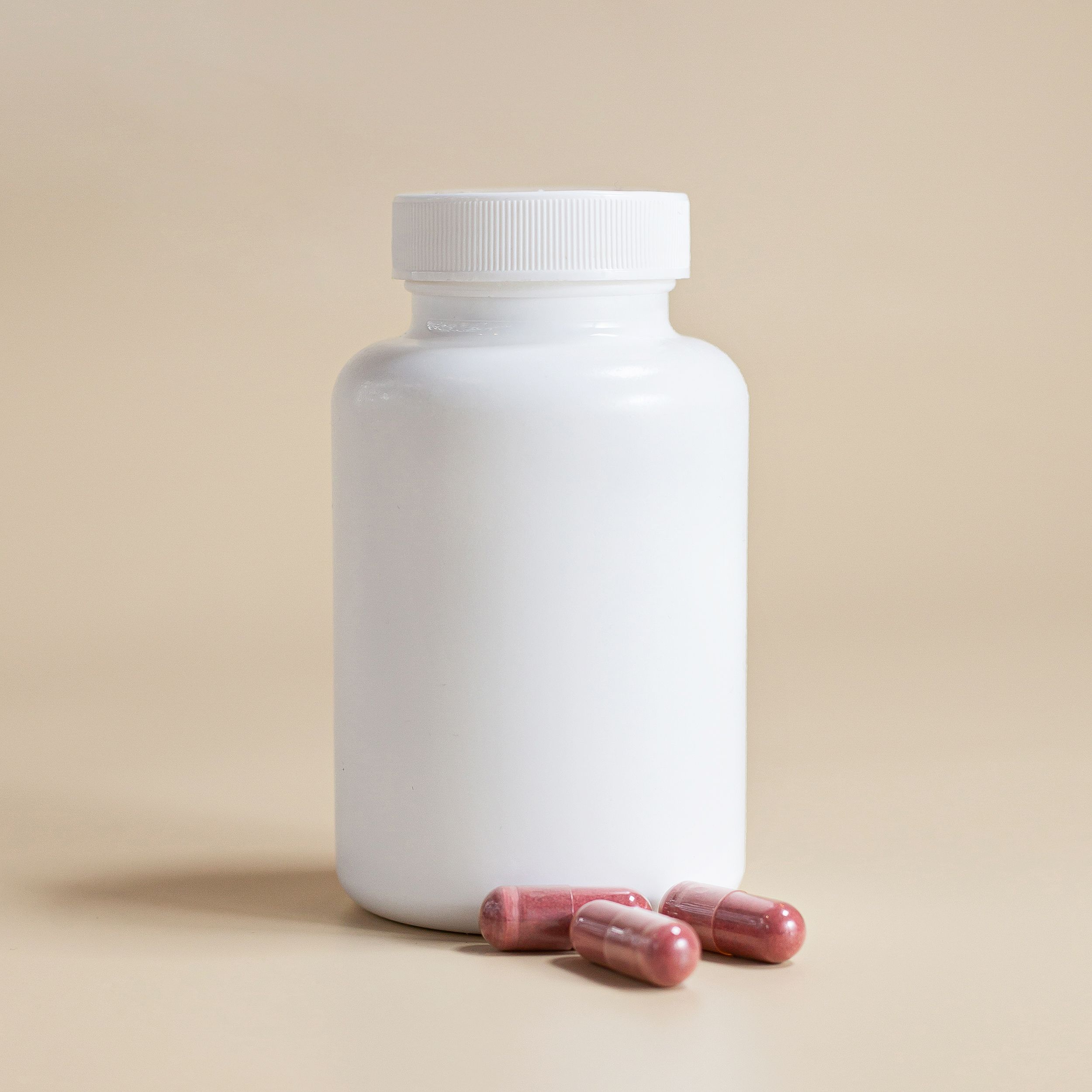
Collagen supplier: two references, two actives
| Capsules | Gummies | |
|---|---|---|
| Active | Cartidyss® type II marine collagen | French eggshell membrane |
| Container | resealable pot of 60 capsules | PET tub of 60 gummies, aluminium lid |
| Intake | 2 capsules daily, at mealtime | 2 gummies a day, between meals |
| Duration | 30 days | 30 days |
| Flavour | not applicable | strawberry, natural flavouring |
| Vitamin C | no | 80 mg per serving |
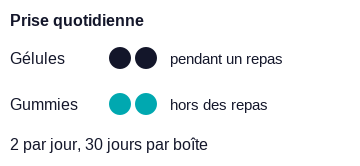
Every sales pitch starts from this table. A customer who avoids seafood can only take the second; someone who would rather swallow a capsule than chew a jelly sweet goes the other way. Neither one suits vegan customers.
The capsules: reading the product sheet
The composition fits on three lines: the Cartidyss® collagen (marine, type II), rice flour as filler, and a plant-based hypromellose shell. Cartidyss® is the name of a patented extract which the product sheet gives as French in origin, sourced from environmentally responsible European fishing; these are transparency points you can quote as they stand. The sheet does not give the amount of collagen per capsule, so do not make one up for your label, which has to carry the exact figure from the file.
Marine collagen comes from fish. At proof stage, check that the allergen line on your label reflects that. Intake is once a day: two capsules taken at mealtime, washed down with plenty of water. The sheet excludes anyone under 18, expectant or nursing mothers, and people on medication, unless a doctor advises otherwise.
The gummies: what a serving contains
| Per 2 gummies (4 g) | Amount |
|---|---|
| Eggshell membrane (REGGENERATE) | 300 mg |
| of which elastin | 76 mg |
| of which collagen | 66 mg |
| of which hyaluronic acid | 10 mg |
| Vitamin C | 80 mg, i.e. 100% of the NRV |
| Carbohydrates | 3.2 g, of which 3.1 g polyols |
| Energy | 8 kcal |
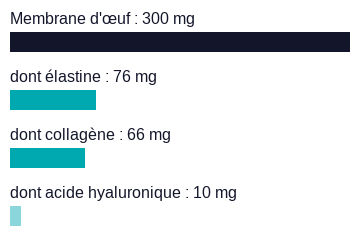
Beyond the active, the gummy is made of maltitol and sorbitol, pectin and citric acid, a natural flavouring of strawberry, beetroot red for colour, then carnauba wax and coconut oil. The carbohydrates (3.2 g per serving) are almost entirely polyols, namely maltitol and sorbitol. Because the active comes from egg, have the allergen line checked on your side before printing: the sheet flags maize and states that the product is not suitable for vegans.
Three components you should be able to name
Collagen and elastin are two proteins; hyaluronic acid is a polysaccharide, a long chain of complex sugars. A salesperson who can define all three in one sentence earns trust, provided they stop at the definition. The milligram figures on the sheet give you the rest: 66 mg of collagen, 76 mg of elastin and 10 mg of hyaluronic acid per serving, and never more than that in your copy.
The only health statement available
With 80 mg of vitamin C per serving, the gummies reach the threshold at which an authorised claim becomes usable, under Regulation (EU) No 432/2012: “Vitamin C contributes to normal collagen formation for the normal function of cartilage.” It is copied word for word and belongs to vitamin C, not to the gummy or the eggshell membrane. Collagen, elastin and hyaluronic acid carry no authorised claim: you may name them as components, nothing more. For the same reason, leave out before-and-after photos, of skin or anything else.
Which format for which customer
With two formats on offer, the grid below lists the simplest things customers say and the reference that answers each one.
| What the customer says | Reference to show |
|---|---|
| “I don’t like swallowing capsules.” | gummies |
| “I don’t eat seafood.” | gummies |
| “I want a named extract I can identify.” | Cartidyss® capsules |
| “I eat neither fish nor egg.” | neither |
The gummies appear in the Gummies, Beauty and Joints White Label catalogues; the capsules fit a beauty display or a joints display equally well. In both cases a one-month course sets a steady repurchase rhythm, which a reseller can tie to a loyalty card.
What your own product page has to repeat
On your website and on the label alike, copy three blocks from the original sheet exactly: the ingredient list with quantities, the recommended intake and the warnings. For the capsules that reads “2 capsules daily, at mealtime”; for the gummies, “2 gummies a day, between meals”. Both references are stored somewhere cool and dry, out of the light, in their closed container. An intake stated differently on your material and on the pack creates an inconsistency for which you alone answer.
Cost per day, an argument at the till
Since one pot or tub covers thirty days at the stated dose, the daily cost for your customer is the recommended retail price divided by 30. That simple figure is easy to say out loud at the counter and reads better than a price per pot; it also gives a fair comparison with a competing product sold for the same length of course. A supplier that shows both the RRP and the duration of the pot gives you all you need for the sum.
A discovery box of several gummies
The gummy sheet notes that they can be combined with other gummies from the same family to put together a discovery box while keeping to one packaging format. The same logic keeps label numbers down: one tub size, several references, one shared design. Pairing capsules and gummies in a single box, by contrast, means handling two containers and two ways of taking them; better to keep them as two separate products on the shelf.
Writing the vitamin C line
The vitamin C health statement only makes sense with the dose beside it: 80 mg for two gummies, or 100% NRV. Put the wording in the area given over to the vitamin, well away from the lines about eggshell membrane, so that no reader links the sentence to the wrong component. On an online store the same rule applies to the product page: a separate “Vitamin C” block, then a “Composition” block for the rest.
What to ask a collagen supplier
Before listing a collagen, put four questions to your contact and keep the answers in writing. Where does the active come from, and does the sheet say so? How much collagen is in one serving, in milligrams? Which allergens appear on the final label, given the raw material? Which health statement is genuinely authorised at the dose shown? A supplier who answers all four precisely saves you corrections at proof stage; one who is vague on any of them leaves the label risk with you.
Questions resellers often ask
What does “type II” mean?
The type refers to the kind of collagen; type II is the one found in cartilage. On the sheet it is a descriptive marker for the product, which you can quote as such without turning it into a promise.
Do the gummies contain sugar?
Their carbohydrates (3.2 g per serving) are nearly all polyols, maltitol and sorbitol. A customer watching this will find the exact value in the nutrition table.
How does the Hexa3 version differ from the White Label one?
The Hexa3-branded version is bought as it is, under the Hexa3 label; the White Label one is sold under yours. Compare both product pages before you decide. The page for the White Label capsules sets out the labelling options.
Can I stock both references?
Yes, from the same supplier, as long as they are clearly told apart on the shelf: two containers, two ways of taking them, two allergen lists.
Should allergic customers be warned?
Yes, through the allergen line on the label: fish for the marine collagen, egg for the gummy membrane. Have it checked at proof stage before printing.
Ordering, neutral or under your label
At Hexa3, both references follow the route described in the launch guide: neutral and unlabelled, or printed with your name and a proof after the order. The pages to open are the Cartidyss® capsules and the gummies; the Collagen category lists them next to their Hexa3-branded counterparts. Our labels are printed in French for now; you can supply your own label in another language for White Label orders.