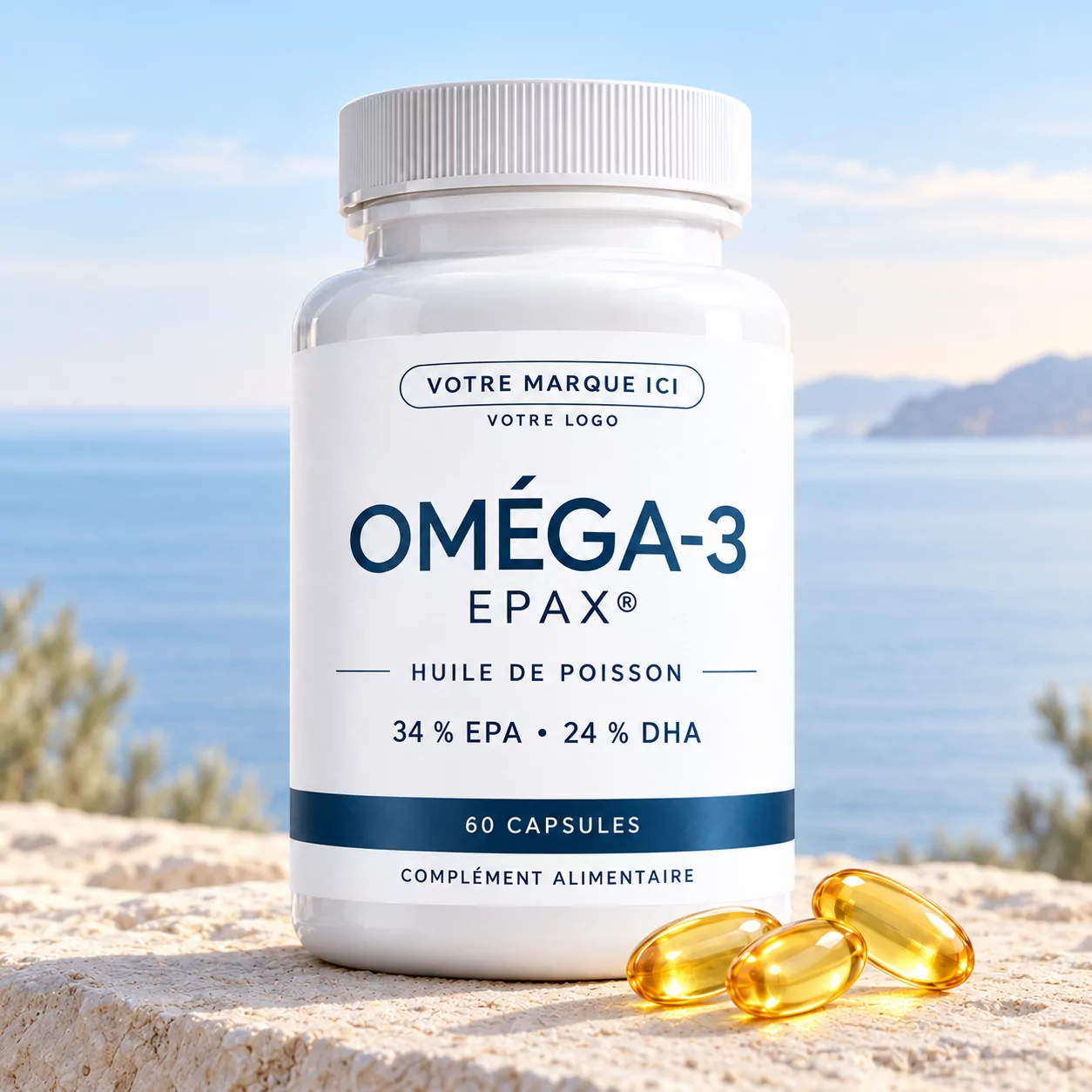
With an omega-3 supplier, three lines of the product sheet tell you what matters: the EPA and DHA content, the freshness index of the oil and the label on the raw material. Hexa3’s reference is an EPAX®-labelled fish oil, made in France, with a TOTOX value below 4, in a pot of 60 softgels. Here is how to read those figures, what the rules allow you to say about them and where the Hexa3-branded pot parts ways with its White Label twin.
The figures behind one serving
| Per softgel | Per serving of 2 softgels | Per pot of 60 | |
|---|---|---|---|
| TG-XO fish oil | 500 mg | 1,000 mg | 30 g |
| Total omega-3 | 320 mg | 640 mg | 19.2 g |
| of which EPA | 170 mg | 340 mg | 10.2 g |
| of which DHA | 120 mg | 240 mg | 7.2 g |
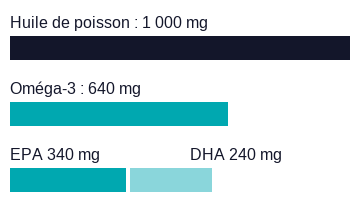
The sheet gives values per two-softgel serving; the other columns are simple division or multiplication. One mix-up to avoid: the 1,000 mg is the weight of the oil, not of the omega-3. Out of 640 mg of omega-3, EPA and DHA add up to 580 mg; the remaining 60 mg are not broken down on the sheet and should not be credited to any particular component.
TOTOX in two sentences
Fish oil oxidises over time, and the TOTOX value is the indicator that measures that oxidation: the lower it is, the less oxidised the oil. It is the sum of two measurements, twice the peroxide value plus the anisidine value, which is why it gets published rather than a single reading. The sheet states a TOTOX below 4. That gives you an objective point of comparison: if another oil’s label does not publish it, the comparison ends there.
Omega-3 supplier: the health statement you may use
The daily serving provides 580 mg of EPA and DHA, above the 250 mg that Regulation (EU) No 432/2012 requires for the heart claim. You may therefore write: “EPA and DHA contribute to the normal function of the heart”, together with its condition of use: the beneficial effect is obtained with a daily intake of 250 mg of EPA and DHA. The wording is always quoted in full.
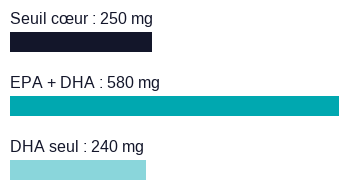
DHA on its own comes to 240 mg, short of the 250 mg needed for the DHA-specific claims. Those cannot appear on this reference, whichever shelf category a shop files it under.
Comparing with another oil’s label
| Line to look for | Why it matters |
|---|---|
| EPA and DHA per serving, in mg | the figure the official claim relies on; an “omega-3” total alone is not enough |
| Number of softgels per serving | without it, two products cannot be compared |
| TOTOX value | the published indicator of how fresh the oil is |
| Fish allergen | a mandatory statement, expected in bold |
| Place of manufacture | a transparency marker, France in this case |
Sizing a first run
For a first order, think in courses rather than in softgels. One pot is a month’s intake for one customer. Ten pots therefore means 600 softgels and ten one-month courses; fifty pots, 3,000 softgels and fifty courses. To choose between a neutral batch and one under your brand, ask in this order: how many regular customers can you reasonably aim for, and over how many months? The answer gives you the number of pots in the first order, not the other way round. Before committing to several months of volume, check the best-before date of the batch you receive.
What the label lets you say
EPAX® is a trade mark, so the ® always goes with it, and the sheet’s own phrasing is the one to reuse (“EPAX®-labelled oil”). The Hexa3 version adds three points from its sheet, to be repeated without inflating them: sustainable fishing, an oil described as GMO-free and free of pollutants and contaminants, and French manufacture. No superlatives, no figures set against a competitor: a recognisable label and plain facts are enough for a conversation at the counter.
Writing the two fatty acids on the label
Use the full names from the sheet followed by their abbreviation: eicosapentaenoic acid (EPA), 340 mg, and docosahexaenoic acid (DHA), 240 mg, for two softgels. Put the daily serving before any other figure, then the oil weight, and keep one unit throughout. A label that switches between “per softgel”, “per serving” and “per pot” makes readers doubt it: choose one basis, the two-softgel serving, and state it at the head of the table.
Tracking repeat purchase of a pot
A pot of 60 softgels runs out after thirty days of regular use. Log the sale date in your customer file: a reminder at the end of the third week, by text message or email, arrives before the customer runs out rather than after. The reasoning holds for any one-month course, and here it applies unchanged, since the sheet sets the rhythm at two softgels a day.
Intake, duration and allergens
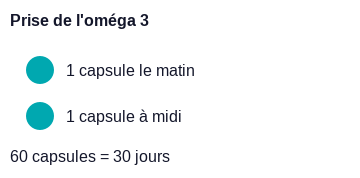
Directions are one softgel in the morning and another at midday, taken with water. Sixty softgels therefore last thirty days. The shell is fish gelatin with glycerol; the ingredient list also includes a mix of tocopherols and rosemary extract. The product contains fish: that allergen has to be spelt out on the label, and since the shell is not plant-based, never present it as such. The sheet says the product is not for women who are pregnant or breastfeeding, and asks for medical advice for anyone on medication.
Two versions, two ways to sell
| Hexa3 brand (HexaPURE® · Essentials) | White Label | |
|---|---|---|
| Principle | you resell a brand already on shelves | you build your own |
| Points from the sheet | EPAX® label, sustainable fishing, oil free from GMOs, pollutants and contaminants, made in France | EPAX® label, TOTOX below 4, made in France |
| Contents | 60 softgels, one month | 60 softgels, one month |
When the same oil comes under two brands, the choice gets simpler: the offers are compared on the label, not on the composition. The HexaPURE® · Essentials page is for those who want to start straight away, and the White Label page for those who would rather see their own name on the pot. Quantities, lead times and options for the latter are in the launch guide. For now our labels exist in French only, and a White Label customer is free to send artwork in another language.
Questions from resellers
What is the difference between fish oil and omega-3?
Fish oil is the raw material; omega-3s are the fatty acids it contains, EPA and DHA among them. The sheet gives the weight of the oil (1,000 mg) and that of the omega-3s (640 mg): two separate figures that must not be confused.
What do I tell a pregnant or breastfeeding customer?
That the product is not intended for her, as the sheet says. No nuance, no dosage advice.
Softgel or capsule: which word should I use?
The sheet refers to soft capsules: a gelatin shell holding a liquid, here the oil, unlike a hard capsule filled with powder. On your label and website, keep one word throughout, “softgel” for instance, so no reader thinks there are two products.
How should intake be presented?
Split it the way the sheet does, a softgel with breakfast and a second one at lunchtime, each with water, and the pot is finished after thirty days.
When you put one omega-3 supplier up against another, ask each the same questions and set the answers side by side: the table above works as the grid.
Listing this omega-3 supplier: checklist
Before you sign off, check five points on the sheet: the EPA and DHA dose in milligrams for two softgels, the TOTOX value, the fish allergen, the number of softgels per pot and the directions. All five can be read in under a minute. Since the same supplier may sell to other resellers too, the list doubles as a benchmark: if any of the five is missing elsewhere, the gap shows at once.
What the counter can answer
Three topics come up: origin (made in France, EPAX®-labelled oil), freshness (TOTOX below 4) and dose (two softgels a day). For anything else, point the customer to the sheet or to a health professional. To compare omega-3 suppliers without misreading the figures, keep this sheet to hand; the Omega-3 category brings together every reference with this active.