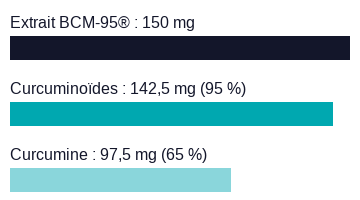
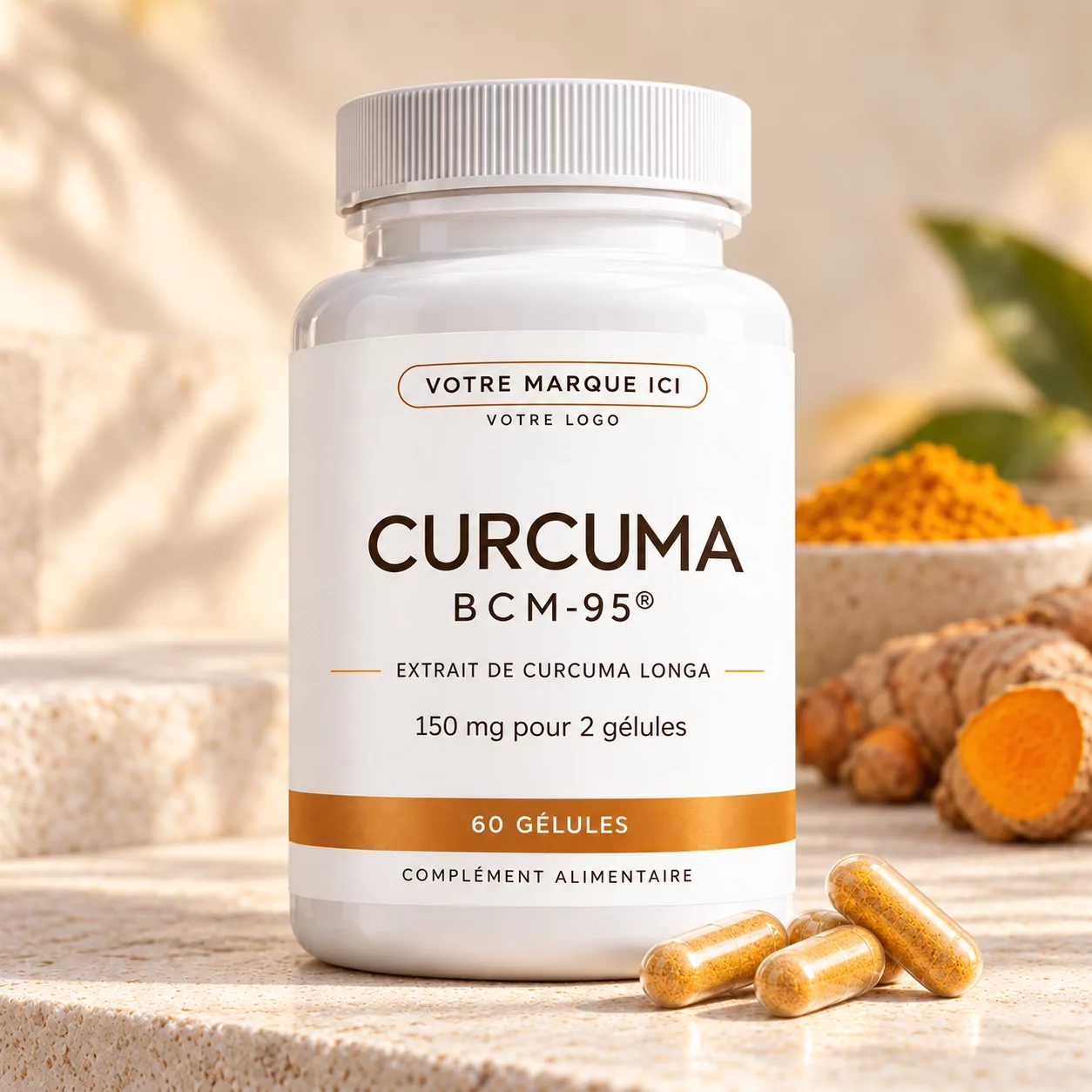
A serious turmeric supplier puts three figures on the product sheet: the weight of extract per dose, its curcuminoid share and its curcumin share. At Hexa3 those figures are 150 mg, 95% and 65%, for a two-capsule dose, and the extract carries the BCM-95® label. This article shows how to read them, what has to sit next to them on the label, and how the Hexa3 version differs from the White Label one, without promising any effect that the rules do not allow.
Reading the three figures on the sheet
The percentages refer to the extract, not to the whole capsule. Out of 150 mg of extract, 95% curcuminoids comes to 142.5 mg, and 65% curcumin to 97.5 mg. Curcumin is the main curcuminoid, one of the yellow pigments found in the root of Curcuma longa. When another jar only states a weight of “turmeric”, without saying whether that means ground root or a standardised extract, these three figures become your selling point.
The ingredient list is short: Curcuma longa extract, acacia gum and a plant-based hypromellose shell. There is no piperine, the black pepper extract that many turmeric products add. According to the trademark holder, BCM-95® takes another route, combining the curcuminoids with the root’s own natural essential oils, such as the turmerones. That manufacturing principle can be described; it must not be turned into a promise.
Comparing two jars like for like
To compare two turmeric products, bring everything back to the daily dose and to the amount of curcuminoids. Take a deliberately made-up example: a jar that states 500 mg of turmeric per dose, using an extract at 5% curcuminoids, supplies 25 mg of curcuminoids. Ours supplies 142.5 mg per dose, a little over five times as much. The sum takes a minute on a competitor’s label, and it stops anyone weighing a powder against an extract, which tells you nothing.
Turmeric vocabulary in five terms
| Term | What it refers to |
|---|---|
| Curcuma longa | the plant species whose root gives the powder and the extracts |
| Standardised extract | an extract with a guaranteed percentage of a given compound |
| Curcuminoids | the group of yellow root pigments, made up of three compounds |
| Curcumin | the most abundant of those three compounds |
| Turmerones | components of the root’s essential oils |
Two versions of one extract
| Hexa3 brand (HexaFLEX®) | White Label | |
|---|---|---|
| Jar | 60 capsules, one month | 60 capsules, one month |
| Label | the Hexa3 label | none, or yours |
| Availability | in stock, ships within 48 h | unlabelled within 24 to 48 h |
| Why choose it | resell a brand customers already know | build your own |
The Hexa3 version, HexaFLEX® · Mobility BCM-95® turmeric, is ordered from your approved trade account. If you need a White Label turmeric supplier, the page for BCM-95® turmeric under your brand sets out quantities and options. The full route, from opening an account to signing off the proof, is in our launch guide, so we will not repeat it here.
Precautions: copy them word for word
This is the part a pharmacist reads first on your label. The product sheet reserves it for adults and advises against it for:
- under-18s, women who are pregnant or breastfeeding;
- anyone on an anticoagulant, an anticancer drug or an immunosuppressant;
- people with bile duct disorders.
It adds the advice to ask a doctor or pharmacist when taking any medicine, and to keep to the daily dose of two capsules. Reproduce the list in full and do not trim it to save space on the label: the proof stage is where you check that it fits the area set aside for it.
Intake and how long a jar lasts
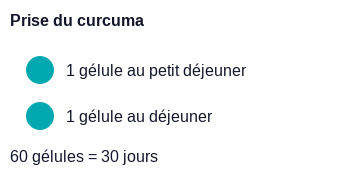
According to the sheet, the first capsule is taken at breakfast and the second at lunch, each with a large glass of water. Two capsules a day from a jar of sixty gives thirty days. A customer who carries on buys again every month, so you can plan on a monthly order cycle rather than holding a large safety stock.
What your sales copy can say
As things stand, the EU register of authorised health claims contains nothing for turmeric. Your selling points therefore stay with product facts: the standardised extract, the BCM-95® label, manufacture in France, the resealable jar, the short excipient list. The framework to check against is Regulation (EU) No 432/2012; a sentence about joints, inflammation or pain falls outside that framework, however often you see it on other websites.
Where to place it, and next to what
| Outlet | Natural spot on the shelf |
|---|---|
| Pharmacy, parapharmacy | with the plant extracts |
| Sports shop | at the till, near the powders and amino acids |
| Wellbeing store, practitioner’s clinic | next to the other supplements in the programme |
| Online store | its own product page, showing the three-figure table |
Online, the BCM-95® label and the three figures give a shopper flicking between jars something concrete to compare. The Turmeric category groups every product built on this ingredient.
Showing the content on the label
The standard line reads: “Curcuma longa extract BCM-95® 150 mg, of which curcuminoids 142.5 mg (95%), of which curcumin 97.5 mg (65%)”, followed by “per 2 capsules”. 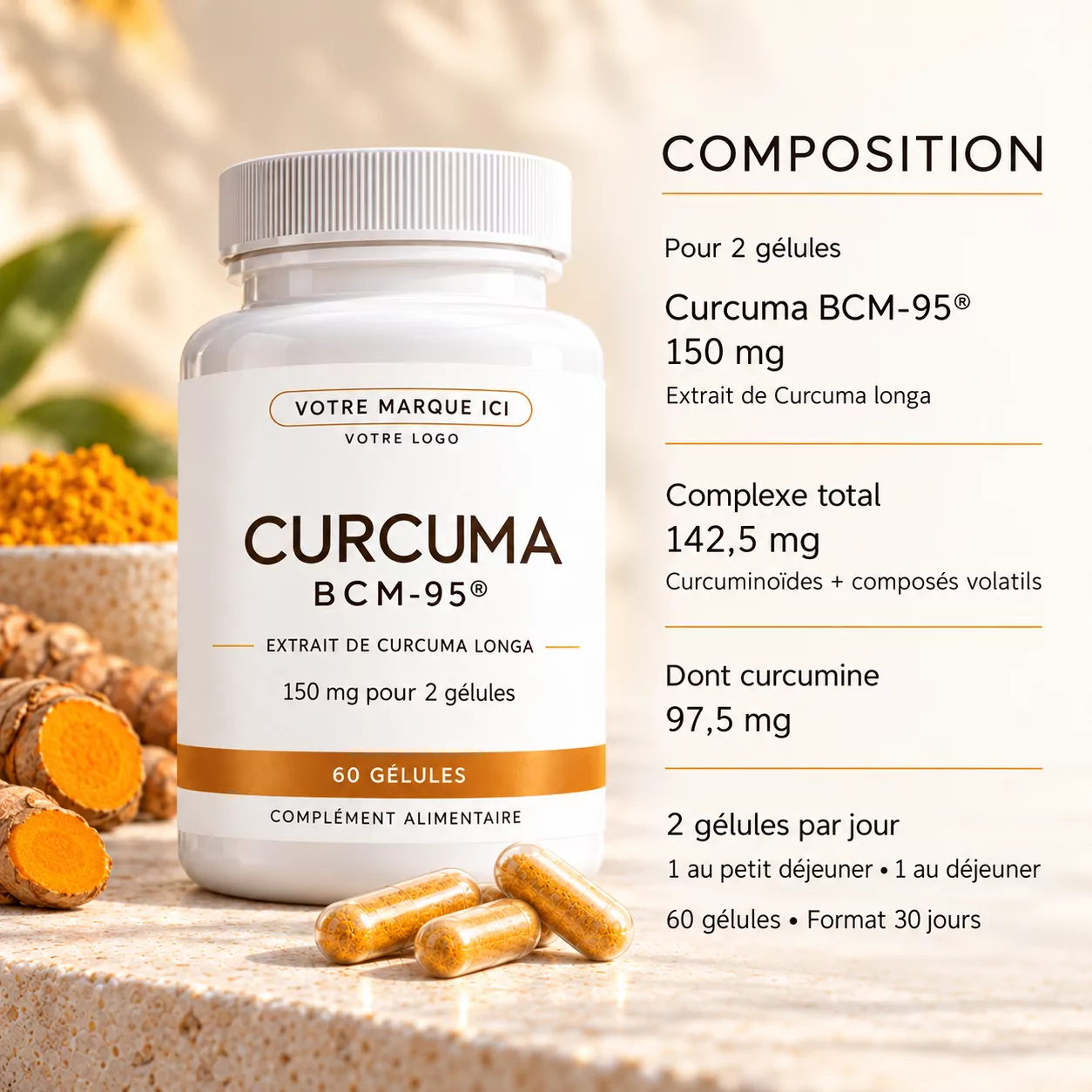
Do not shorten it to “turmeric 150 mg”, which suggests 150 mg of ground root. Put the percentages in brackets after the milligrams, so the customer reads the actual quantity first.
Presenting BCM-95® without overselling it
BCM-95® is a registered trademark: always write it with its symbol, and attribute its principles to the holder (“according to the trademark holder”). What can be said about this extract fits into three clear points: a standardised extract, a label, a described process. On those three points your sales staff can answer without improvising. For anything else, the honest answer is a single sentence: that is not on the product sheet.
Stock and reorders at Hexa3
A turmeric supplier that keeps the product in stock spares you from tying up cash. The Hexa3-branded version is held in our stock, with dispatch announced within 48 h. You order as your sales go rather than sitting on a reserve: a one-month jar is reordered once the month is up. The White Label version follows the route set out in the guide, and your label stays on file from one reorder to the next.
Retailer questions
Does the ingredient list contain anything of animal origin?
No: the extract, the acacia gum and the hypromellose all come from plants. Even so, only print “vegan” on your label after asking Hexa3 for the supporting documents, because that wording commits your brand.
What do I tell a customer who is on medication?
Point them to the wording on the sheet: ask a doctor or pharmacist, and do not take the product alongside anticoagulant, anticancer or immunosuppressant medication. That answer is given as it stands, with no softening.
Should piperine come up at all?
Only to say it is not in the formula. If you compare with a product that contains it, quote that product’s ingredient list, not your impression of it.
Five questions to put to a turmeric supplier
To choose between two offers, send each turmeric supplier the same list: which extract, standardised to how much curcuminoids and curcumin; what daily dose; which precautions appear on the sheet; what the minimum order is, unlabelled and personalised; how long a reorder takes. The five answers fit on one page. A turmeric supplier who answers only three leaves you guessing the rest at proof stage, which is too late to amend a file calmly.
Four checks before you list it
Four checks are enough before you add this turmeric supplier to your catalogue.
- The content on your label matches the “curcuminoid complex 95%” line on the sheet.
- The complete list of precautions appears on the jar and on the web page.
- No sentence on your product page describes an effect on the body.
- The two-capsule dose is the only one shown, printed materials included.