HexaFLEX®
PEA 90 Capsules x 400 mg OptiPEA®
Prices for trade customers only
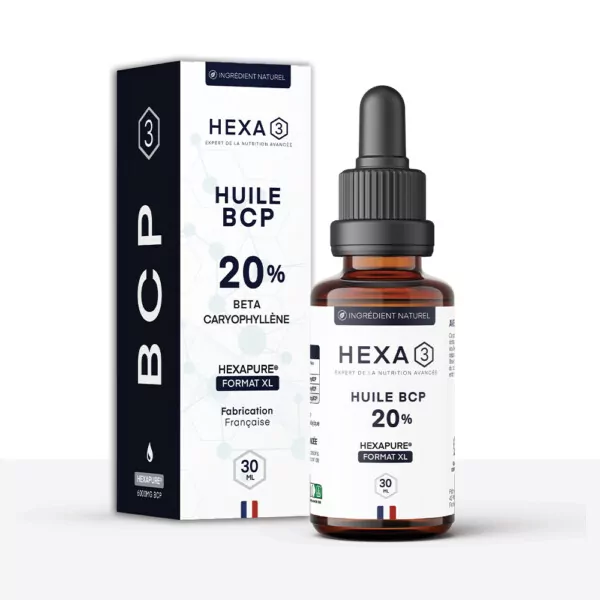
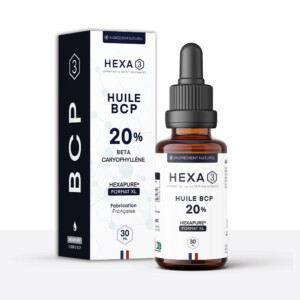
Log inLooking for a line that does not resemble the usual shelf? The beta-caryophyllene oil from HexaPURE® · Essentials comes in a 30 ml bottle fitted with a dropper, 600 drops per bottle at a concentration of 20% BCP. It needs no long speech: the label fits in two lines, and nobody has to explain an endless formula.
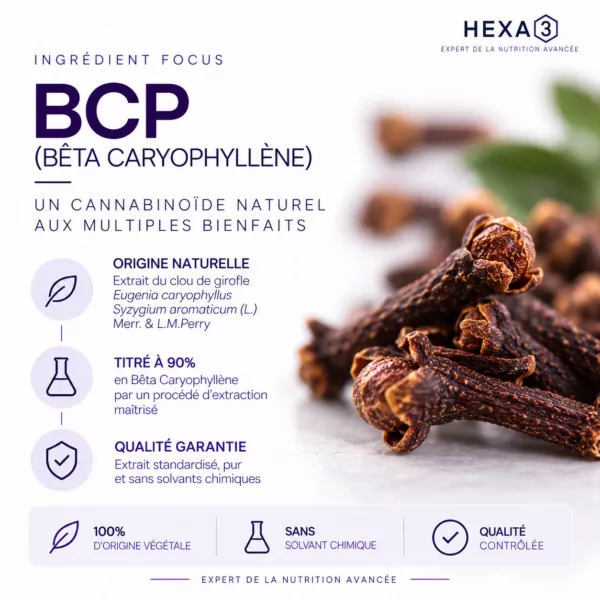
BCP is a terpene that occurs naturally in clove and black pepper. Here it comes from a clove bud extract suspended in fractionated coconut oil from organic farming. No additive, no preservative. Vegan and GMO-free, it is bottled in France. Its label is printed in French; there is no translated edition for the time being.
This beta-caryophyllene oil contains no CBD, which sets it apart from most of the oil shelf. That helps a shop still hesitant about hemp, or one that wants a product customers can compare without reading a cannabinoid label.
Beta-caryophyllene has no authorised health claim, so there is nothing to make up. The pitch rests on checkable facts:
Authorised wording is published in Regulation (EU) No 432/2012; that list sets the limits for your sales material.
A pharmacy assistant often has a few seconds with each customer. With this bottle they can say it holds 600 drops, that the active comes from clove and that the base is organic coconut oil. Nothing else to memorise. Staff in a nutrition shop appreciate this kind of product: it is presented in under ten seconds and never pushes anyone to improvise about what the law forbids them to promise.
Customers who already buy drop oils know the format. The dropper measures without a spoon, and the 30 ml bottle sits easily on a counter display or in an e-commerce parcel.
For an online retailer the listing is quicker to write than for a supplement with a long list of actives: one terpene, one base, one format. The product sums up in a line. Belonging to the HexaPURE® · Essentials range gives you a ready-made category for your catalogue, with no need to invent a new one.
On a pharmacy or parapharmacy shelf it plays the curiosity role: a rarely seen ingredient beside the HexaPURE® staples. In an organic or nutrition shop it belongs with the sublingual oils. For a web retailer it is a page that stands apart from the CBD listings already indexed.
Recommended retail price: €59.90 incl. VAT. A bottle lasting several weeks lends itself to a cost-per-day argument that customers grasp quickly, and to a repeat sale when it runs out.
For a first order you can add it to a wider basket, then restock once you have seen how it turns over. Sales over the first weeks will tell you whether to double the facing.
The full technical sheet stays available on this page.
A version under your own name also exists: the same oil as White Label, delivered unlabelled or customised, for anyone who would rather build their own line than resell HexaPURE®.
Documents réservés aux professionnels · Log in
Eugenia caryophyllus (Syzygium aromaticum (L.) Merr. & L.M. Perry) Clove bud extract, standardised to 90% beta-caryophyllene (BCP)
Fractionated C8 coconut oil, from organic farming
| Ingredient | Role | Origin |
|---|---|---|
| Eugenia caryophyllus (standardised to 90% BCP) | Main active ingredient | Clove bud extract |
| Fractionated C8 coconut oil (organic) | Carrier | Organic farming |
| Serving | Amount of extract | Of which BCP |
|---|---|---|
| 1 drop (0.05 ml) | 11.1 mg | 10 mg |
| 5 drops (0.25 ml) | 55.5 mg | 50 mg |
| 10 drops (0.50 ml) | 111 mg | 100 mg |
Total per bottle (30 ml): 6,000 mg of BCP, i.e. 600 drops
It is recommended to take 5 to 10 drops a day as needed. For better bioavailability, place the drops under the tongue and wait one minute before swallowing: the sublingual route lets the ingredient pass more directly, bypassing part of the digestive tract.
| Level | Drops per day | Amount of extract | Of which BCP | Note |
|---|---|---|---|---|
| Discovery | 1 drop | 11.1 mg | 10 mg | For a first try, at the start of a course |
| Light | 3 drops | 33.3 mg | 30 mg | Moderate daily use |
| Standard | 5 drops | 55.5 mg | 50 mg | Reference dose recommended on the label |
| Increased | 8 drops | 88.8 mg | 80 mg | For a higher intensity as needed |
| Maximum | 10 drops | 111 mg | 100 mg |
This product is a food supplement: it is not a substitute for a varied and balanced diet or a healthy lifestyle. Do not exceed the recommended daily dose. Keep out of the reach of young children.
Store in a cool, dry place, away from light.
Référence : Mazzantini et al., "Anti-Inflammatory Properties of Cannabidiol and Beta-Caryophyllene Alone or Combined in an In Vitro Inflammation Model", publiée dans Pharmaceuticals (2024), revue à comité de lecture indexée PubMed (facteur d'impact 5,7). L'article a reçu le Best Paper Award de la revue en 2026.
Les chercheurs ont voulu évaluer les effets anti-inflammatoires du CBD (cannabidiol) et du BCP (bêta-caryophyllène), séparément puis en association, sur un modèle de cellules cutanées humaines (kératinocytes) soumises à une inflammation provoquée en laboratoire.
Les kératinocytes humains (lignée HaCaT) ont été exposés à une substance inflammatoire (LPS), en présence ou non de CBD et/ou de BCP à différentes concentrations. Les chercheurs ont ensuite mesuré plusieurs marqueurs de l'inflammation (protéines et gènes pro-inflammatoires) pour observer si les deux composés parvenaient à contrer la réaction inflammatoire déclenchée.
Les auteurs concluent que l'association CBD/BCP permettrait d'obtenir un effet anti-inflammatoire notable tout en utilisant des doses plus faibles de chaque composé, ce qui pourrait limiter les effets indésirables associés à des concentrations plus élevées. Ils soulignent toutefois que l'étude a été menée in vitro (en laboratoire, sur cellules) et que des recherches complémentaires in vivo seraient nécessaires pour confirmer ces résultats sur la peau humaine dans des conditions réelles.

Manage cookies
We use cookies to measure traffic and improve the site. You can accept, refuse or choose.
Functional
Always onEssential for the site to work: basket, login to your account, security, remembering your cookie choices. They are never used for any other purpose.
Statistics
Audience measurement (Google Analytics) to see which pages are useful to you and improve the site. The data is aggregated.
Marketing
Tracking of where orders come from (where you arrived from) and embedded third-party content (YouTube videos, maps).