White Label BCP Oil 20% 30 ml
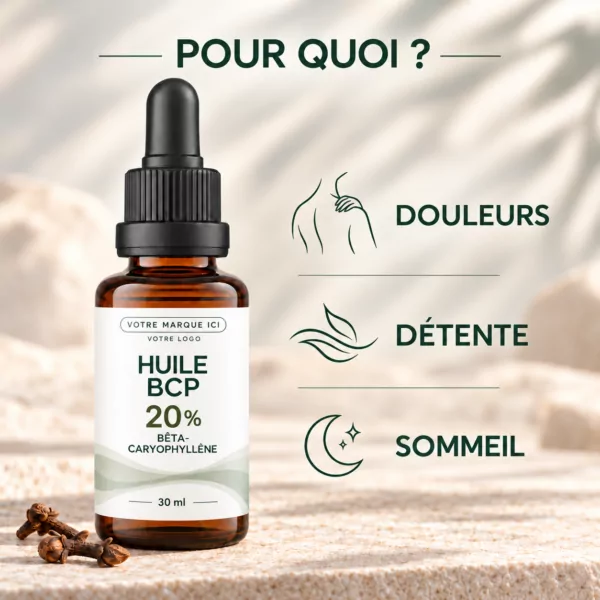
- 30 ml
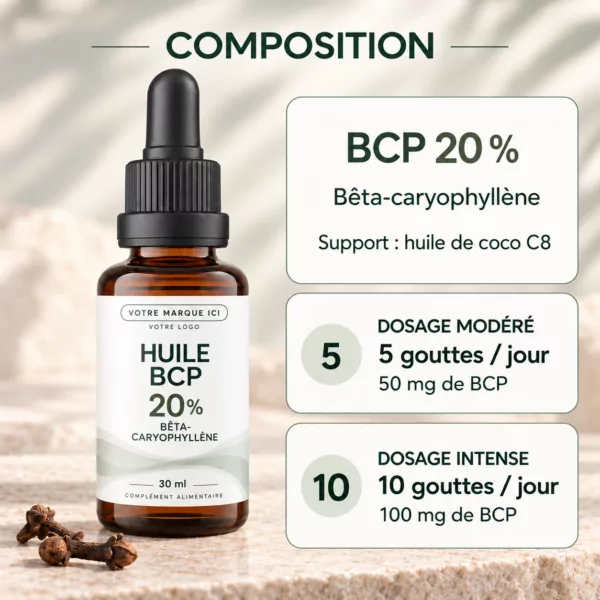
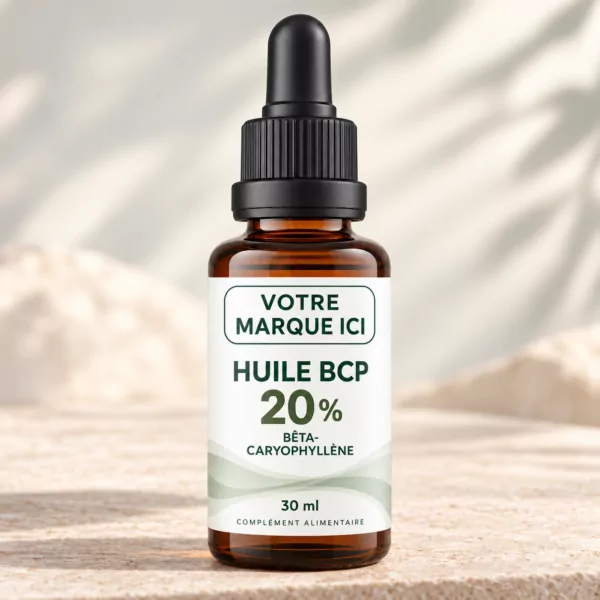
- 30 ml dropper bottle, 600 drops
- 20% BCP oil, CBD-free, vegan, made in France
Trade prices for professionals only
- Sliding prices excl. VAT depending on the quantity ordered
- Trade account approved within 24-48 working hours
- From 10 units without a label, 50 units under your brand
- Without a label: dispatch within 24-48 working hours
- Under your brand: 48-72 h for restocks, 10 working days after proof approval for a first order
- Shipping costs calculated at checkout
- Payment by card or bank transfer
Description
Launching a white label BCP oil means offering an ingredient your competitors have not put on the shelf yet. The product is a 30 ml dropper bottle holding 600 drops at 20% beta-caryophyllene, already formulated and made in France. All that is left is to put your name on it.
The formula in two sentences
A clove bud extract rich in BCP, carried by fractionated coconut oil of organic origin. Nothing more: no preservative, no additive, vegan and GMO-free. The label you print will be short, and its notification easier to check.
What the label may say
Beta-caryophyllene is a terpene found in clove and black pepper. It has no authorised health claim. In practice your copy describes the origin, the plant carrier, the format and French production, and attributes no effect to the product. The reference text is Regulation (EC) No 1924/2006 on nutrition and health claims.
Another plus for a brand founder: this oil contains no CBD. It can sit in a range without any hemp products, or complement a hemp line without duplicating it.
Who it suits
- supplement brand founders looking for an unusual lead product;
- pharmacies and parapharmacies that want an oil under their own banner;
- shops and online retailers specialising in plant-derived ingredients.
Your own bottle or someone else's brand
Reselling an oil under another company's brand leaves you tied to its retail price and its online visibility. With your label you set the price, keep the customer relationship and restock in the same format without starting over. BCP is still a rare ingredient, and the brand that adds it early gets it established before the others arrive.
You control the identity from end to end, from the range name to the wording of the product page.
One example: a wellbeing brand already selling gummies and capsules adds its BCP oil as a seasonal launch, with a name, colour and tagline of its own choosing. The 30 ml bottle fits in a gift box, a mail-order parcel or on a pharmacy shelf with no change to logistics.
Ordering terms
Without a label, allow 10 units minimum and dispatch in 24 to 48 h. Printed with your label, the floor becomes 50 bottles, and production starts about 72 h after your proof is approved. The proof comes after the order, from your account, and a repeat order with a label already approved skips it.
The "Printing & application" option covers both printing the label and applying it. The label measures 8.5 × 4.5 cm and is produced by a specialist printer, so the option is priced separately or quoted, the template is sent on request, and the lead time may run a little longer. You may also hand us your finished label, which we pass on to the printer. Our standard label text is in French; a label in your customers' language is accepted if it includes the compulsory mentions.
Hexa3 can also take care of graphic design, the mockup, the barcode and the Compl'Alim notification (DGAL).
If you are building a line around this terpene, a version with melatonin is also available as White Label.
Trade documents
Documents réservés aux professionnels · Log in
Ingredients
Composition
Active ingredient
Eugenia caryophyllus (Syzygium aromaticum (L.) Merr. & L.M. Perry) Clove bud extract, standardised to 90% beta-caryophyllene (BCP)
Other ingredients
Fractionated C8 coconut oil, from organic farming
Detailed composition table
| Ingredient | Role | Origin |
|---|---|---|
| Eugenia caryophyllus (standardised to 90% BCP) | Main active ingredient | Clove bud extract |
| Fractionated C8 coconut oil (organic) | Carrier | Organic farming |
Active content per serving
| Serving | Amount of extract | Of which BCP |
|---|---|---|
| 1 drop (0.05 ml) | 11.1 mg | 10 mg |
| 5 drops (0.25 ml) | 55.5 mg | 50 mg |
| 10 drops (0.50 ml) | 111 mg | 100 mg |
Total per bottle (30 ml): 6,000 mg of BCP, i.e. 600 drops
Directions for use
It is recommended to take 5 to 10 drops a day as needed. For better bioavailability, place the drops under the tongue and wait one minute before swallowing: the sublingual route lets the ingredient pass more directly, bypassing part of the digestive tract.
Dosage by chosen intensity
| Level | Drops per day | Amount of extract | Of which BCP | Note |
|---|---|---|---|---|
| Discovery | 1 drop | 11.1 mg | 10 mg | For a first try, at the start of a course |
| Light | 3 drops | 33.3 mg | 30 mg | Moderate daily use |
| Standard | 5 drops | 55.5 mg | 50 mg | Reference dose recommended on the label |
| Increased | 8 drops | 88.8 mg | 80 mg | For a higher intensity as needed |
| Maximum | 10 drops | 111 mg | 100 mg |
Warnings
This product is a food supplement: it is not a substitute for a varied and balanced diet or a healthy lifestyle. Do not exceed the recommended daily dose. Keep out of the reach of young children.
Store in a cool, dry place, away from light.
Etudes sur le BCP
Référence : Mazzantini et al., "Anti-Inflammatory Properties of Cannabidiol and Beta-Caryophyllene Alone or Combined in an In Vitro Inflammation Model", publiée dans Pharmaceuticals (2024), revue à comité de lecture indexée PubMed (facteur d'impact 5,7). L'article a reçu le Best Paper Award de la revue en 2026.
Objectif de l'étude
Les chercheurs ont voulu évaluer les effets anti-inflammatoires du CBD (cannabidiol) et du BCP (bêta-caryophyllène), séparément puis en association, sur un modèle de cellules cutanées humaines (kératinocytes) soumises à une inflammation provoquée en laboratoire.
Méthode
Les kératinocytes humains (lignée HaCaT) ont été exposés à une substance inflammatoire (LPS), en présence ou non de CBD et/ou de BCP à différentes concentrations. Les chercheurs ont ensuite mesuré plusieurs marqueurs de l'inflammation (protéines et gènes pro-inflammatoires) pour observer si les deux composés parvenaient à contrer la réaction inflammatoire déclenchée.
Principaux résultats
- Innocuité : ni le CBD ni le BCP, seuls ou combinés, n'ont montré de toxicité pour les cellules aux concentrations testées.
- Effets individuels : le CBD comme le BCP ont chacun réduit significativement les marqueurs inflammatoires induits par le LPS, mais via des mécanismes différents. Le CBD agit via le récepteur PPARγ, tandis que l'action du BCP passe spécifiquement par le récepteur CB2 du système endocannabinoïde — un antagoniste du CB2 a d'ailleurs annulé l'effet anti-inflammatoire du BCP dans l'étude, confirmant ce mode d'action.
- Effet combiné supérieur : associés, CBD et BCP ont produit un effet anti-inflammatoire plus marqué que chaque composé pris isolément, y compris à des doses plus faibles. Les auteurs expliquent cette synergie par le fait que les deux molécules activent des voies biologiques distinctes et complémentaires.
Conclusion des auteurs
Les auteurs concluent que l'association CBD/BCP permettrait d'obtenir un effet anti-inflammatoire notable tout en utilisant des doses plus faibles de chaque composé, ce qui pourrait limiter les effets indésirables associés à des concentrations plus élevées. Ils soulignent toutefois que l'étude a été menée in vitro (en laboratoire, sur cellules) et que des recherches complémentaires in vivo seraient nécessaires pour confirmer ces résultats sur la peau humaine dans des conditions réelles.