Hexa3’s White Label probiotic strains come as a three-species formula delivering 10 billion CFU per two-capsule dose, with chicory fibre and vitamin C. That 10 billion total is the number people notice first, and it is also the one that tells you least. What sets a serious product sheet apart is how the count is shared between species. This article explains how to read that split, what the formula lets you write, and how to present storage.

White Label probiotic strains: the figures on the sheet
CFU stands for colony-forming units: a count of bacteria able to multiply, not a weight.
| Strain | CFU per dose | Weight of culture per dose |
|---|---|---|
| Lactobacillus rhamnosus | 6 billion | 30 mg |
| Lactobacillus acidophilus | 2.7 billion | 180 mg |
| Bifidobacterium bifidum | 1.3 billion | 4.34 mg |
| Total | 10 billion | 214.34 mg |
Why weight does not tell you the count
The table holds a surprise. Acidophilus weighs 180 mg for 2.7 billion CFU, while rhamnosus weighs 30 mg for 6 billion. Per milligram, rhamnosus packs 200 million CFU, acidophilus about 15 million and bifidum about 300 million. Culture powders are not equally concentrated from one strain to the next, so two strains of the same weight can hold very different numbers of bacteria.
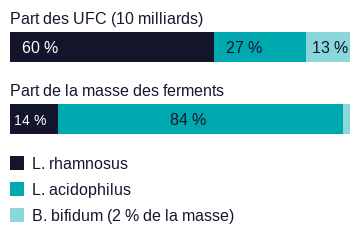
In practice, a customer who reads “180 mg” and decides acidophilus is the main strain is looking at the wrong indicator. To compare two products, set CFU against CFU, strain by strain.
Strain, species, genus: what the sheet names

| Level | Example from the formula |
|---|---|
| Genus | Lactobacillus, Bifidobacterium |
| Species | rhamnosus, acidophilus, bifidum |
| Strain | a code of letters and numbers added after the species |
For these White Label probiotic strains, the sheet names the species but gives no strain code. So do not add one from memory on your label: ask Hexa3 for it if you want to show it. Species names go in italics, with a capital letter on the genus only. One useful detail: a 2020 revision of bacterial taxonomy renamed several Lactobacillus, and Lactobacillus rhamnosus now also goes by Lacticaseibacillus rhamnosus. The sheet uses the older name; check with us which one to print on your label.
Prebiotic and synbiotic: the terms
The formula contains 330 mg of chicory fibre. A fibre that accompanies live bacteria is called a prebiotic, and a product combining a probiotic with a prebiotic is called a synbiotic. Both are descriptive words, checkable against the sheet: they name what is in the capsule, not what it does. The fibre accounts for 330 mg of the 1,074 mg in a dose, a little under a third of the contents and far more than the cultures themselves (214.34 mg). The remaining ingredients are maltodextrin as a bulking agent, magnesium stearate as an anti-caking agent and a plant-based capsule. You will find this ingredient in the Chicory fibre category, and the other products on the Probiotics ingredient page.
The only health statement on the sheet
A dose supplies 40 mg of vitamin C, or 50% of the reference intake, which clears the 15% threshold. Regulation (EU) No 432/2012 then allows this exact wording: “Vitamin C contributes to the normal function of the immune system.” It belongs to the vitamin C. Attribute no effect at all to the strains themselves: the statement covers the vitamin only.
What one jar holds, in numbers
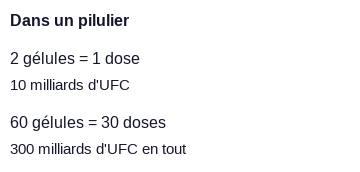
Two capsules give 10 billion CFU, an average of 5 billion per capsule, and their contents weigh 1,074 mg. A 60-capsule jar holds 30 doses, so 300 billion CFU in total. On the label, write the numbers in words followed by scientific notation in brackets, for example 6 billion (6 × 10⁹): a reader in a hurry will not count zeros. These totals help you understand the sheet and work out quantities; they do not replace the per-dose line, which is the only value to print.
Intake, duration, who it is for
The sheet advises two capsules, taken in the morning ahead of eating. The jar holds sixty, so thirty days. It excludes pregnant or breastfeeding women and children under 15, unless a doctor advises otherwise. Carry both sentences over unchanged to your label and website.
Storage, without making up instructions
The sheet gives two instructions: preferably keep refrigerated once opened, and store in a cool, dry place. Reproduce both in their exact wording and do not swap them for a phrase of your own. In a shop, that means a shelf away from heat and a clear message to the customer about the jar once it is open.
What to write and what to leave out
| Write | Do not write |
|---|---|
| the three species and their CFU | any effect attributed to a strain |
| the presence of 330 mg of chicory fibre | any effect attributed to the fibre |
| the official vitamin C statement, word for word | a paraphrase of that statement |
| refrigeration once opened | a shelf life you made up |
The EU register of claims is the only reference. For White Label probiotic strains as for any supplement, if you are unsure about a sentence, leave it out: a missing sentence costs less than an inspection.
Reading another probiotic’s label
Three lines are enough to size up a competing product. First, the species and strains named: a product that only says “a blend of cultures” is not telling you what is inside. Next, the CFU count for each species, and then the daily dose it refers to: 10 billion for two capsules and 10 billion for one are not the same thing. For any given batch, the best-before date is printed on the pack.
Your first order
With White Label probiotic strains sold in a one-month jar, plan your opening quantity in customers on a monthly course: ten jars for ten customers over one month. Since the sheet asks for refrigeration once opened, small, regular reorders work better than a large stock sitting in the back room. On the paperwork side, the supplement must be notified before the first sale; in France this is done on Compl’Alim, and the steps are set out in our article on filing on Compl’Alim.
Order, label, notify
These White Label probiotic strains come in a plain, unlabelled jar or under your own brand; minimums, lead times and the role of the proof are described once and for all in our launch guide. The White Label probiotics product page carries the composition, advice and warnings tabs to copy across.
Retailer questions
Should the CFU count appear on the label?
Yes. For White Label probiotic strains, give it strain by strain, for the two-capsule daily dose, using the figures on the sheet: 6, 2.7 and 1.3 billion.
Is the 10 billion enough to compare two products?
No. It tells you neither how many strains there are nor how the count is shared. Compare three lines: the species, the CFU per species, the daily dose.
How should the vitamin C be presented?
As an ingredient of the formula that carries an official statement, quoted exactly. Do not tie that sentence to any other promise.
How do I compare two offers of White Label probiotic strains?
Line up five points: the species named, the CFU of each, the daily dose, whether there is a prebiotic, and the storage instruction. Offers that only give the total cannot be compared with this one.
What does “bulking agent” mean in the list?
It is a technical ingredient that gives volume to the powder inside the capsule, in this case maltodextrin. It appears in the list, like the magnesium stearate, without being promoted in any way.