To resell PEA, you first need to name precisely what you are selling. PEA, or palmitoylethanolamide, is supplied here under the OptiPEA® trademark: plant-derived, made in Europe, in 400 mg capsules packed 90 to a pot. Health wording is tightly regulated, so your sales pitch has to rest on the facts in the product sheet. This piece sets out what can be said, what cannot, and how to present the directions of use.
The product sheet in figures
| Item | Value on the sheet |
|---|---|
| Active | OptiPEA® PEA, plant-derived |
| Dose | 400 mg per capsule |
| Contents | 90 capsules, pot supplied unlabelled |
| Directions | 1 capsule in the morning, 1 at lunch, 1 in the evening, with the meal |
| Maximum | 3 capsules per 24 h, i.e. 1,200 mg |
| How long a pot lasts | 30 days at the maximum dose |
| Other ingredients | acacia gum, hypromellose shell |
| Country of manufacture | Europe |
According to the sheet, the three capsules are split over the day’s meals and washed down with plenty of water; three is the ceiling. A retailer has no business recommending more or suggesting a “boosted” dose.
Reselling PEA without mixing it up with CBD
Retailers used to CBD are often tempted to link the two ingredients in their pitch. Resist it: PEA and CBD are two separate substances, and no sales text should present one as a stand-in for the other. Each has its own sheet, composition and precautions. If your shop stocks both, shelve them apart and never pair them in the same sentence.
What you may write, and what goes too far
| Allowed | Out of bounds |
|---|---|
| the name of the active and its OptiPEA® trademark | any effect on pain, stress or sleep |
| 400 mg per capsule, 3 capsules maximum | a “boosted” dose |
| plant origin and manufacture in Europe | a comparison with another ingredient |
| the ingredient and allergen list | a figure-based result or a customer testimonial |
We found no authorised wording linked to PEA in the 2012 EU list of health claims, so the sales copy stays descriptive. What you can do is spell out the composition in detail, which answers the questions a careful customer will ask about what is inside.
Precautions and allergens to carry over
Under-18s, pregnant women, breastfeeding women and people on medical treatment: the sheet excludes these four groups, and your label must name them. It also states that the product is made on equipment that handles milk, eggs, soy, fish and wheat, and that allergen statement has to appear on your label. The standard reminder that supplements are no stand-in for a balanced, varied diet goes on the label word for word. Keep the pot closed, somewhere cool and dry, away from light.
One day of use, made simple

| When | Capsules | Taken with |
|---|---|---|
| Breakfast | 1 | a large glass of water |
| Lunch | 1 | a large glass of water |
| Dinner | 1 | a large glass of water |
This table fits on a counter card or in a tab of your web product page. Its strength is that every figure in it comes straight from the sheet.
Working out what a pot contains
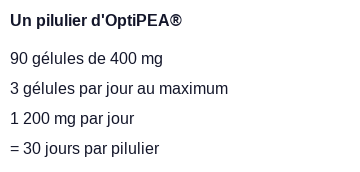
Ninety capsules of 400 mg come to 36 g of PEA per pot, or 1,200 mg a day for thirty days. Those two numbers help anyone filling in a notification or a technical file; they are not a selling point. The figure to remember is the duration: one pot covers a month, and a customer who carries on buys a new pot each time it runs out.
Building the product page on your website
Open with the exact name of the active and its trademark, written OptiPEA®, followed by the dose per capsule and the directions. Precautions and allergens come straight after, ahead of any marketing content. A photo of the labelled pot closes the page. That order matches what a professional buyer looks for first, and it protects you: mandatory information comes before optional information.
A word on the name: OptiPEA® is the ingredient’s trademark, not your brand and not a generic product name. Always write it with its registered sign.
Which kinds of reseller
| Profile | What the product sheet gives them |
|---|---|
| Pharmacy, parapharmacy | a three-ingredient list, full precautions, country of manufacture |
| Practitioner | a single reference to carry under their own name, with split dosing that is easy to hand over in writing |
| Bricks-and-mortar shop | a 90-capsule pot that lasts one month, shelved alongside other one-month supplement courses |
| Online retailer | a fully documented product page with no wording that needs justifying |
| Brand founder | an active identified by its trademark, rounding out an existing range |
Terms used on the sheet
| Term | Meaning |
|---|---|
| Palmitoylethanolamide | the full chemical name of PEA |
| OptiPEA® | the trademark under which the ingredient is supplied |
| Acacia gum | a plant-derived ingredient added to the formula |
| Hypromellose | the plant-based material of the capsule shell |
| Allergen | a substance that must be flagged on the label, here because of shared production equipment |
Four checks before you list it
- The label shows the 400 mg dose per capsule and the number of capsules in the pot.
- The warnings include the limit of three capsules per 24 h.
- The allergen line names all five substances from the sheet.
- The made-in-Europe statement matches the sheet word for word.
Briefing your sales staff
The whole brief fits on one card: three figures to know (400 mg per capsule, three capsules at most, one pot per month), three topics to stay away from (pain, stress, sleep), and one answer when a customer pushes, which is to refer them to a healthcare professional. Staff who resell PEA this way never have to improvise on a subject where improvising puts the brand at risk.
What changes on a label under your name
On the Hexa3 version, the distributor line names Hexa3. On a version under your brand, the legal line for the business placing the product on the market carries your company name and address, since you are the one notifying the product. Composition, dose and precautions stay exactly the same: only the name, the logo and that legal line become yours.
Shelving the pot
In a pharmacy or shop, display the pot with its label facing out and the directions card beside it, never next to a sign that talks about pain or flexibility. A retailer who decides to resell PEA also has to think about what sits next to it: placing it between two other one-month courses keeps the message clear, whereas a shelf that puts it beside wellbeing or sleep products invites links the label does not allow.
Hexa3 version or your own brand
There are two product pages: OptiPEA® PEA HexaFLEX® · Mobility is resold under the Hexa3 brand, while the White Label page is the starting point for yours, plain or personalised. To resell PEA under your own name, every step from minimum order to lead times and proof approval is set out in the launch guide. Other products built on this active are grouped in the PEA category.
Questions from resellers
What should I say when a customer asks what PEA is for?
Give the name of the active, its trademark, the dose, the suggested directions and the precautions. For anything about what it does in the body, suggest they speak to a healthcare professional: that is the only compliant answer.
Do I need a product name to resell PEA under my brand?
Yes. Your product name goes on the label alongside the name of the active and its trademark. Pick it before the proof stage, because the notification depends on it.
Can a customer take more than three capsules?
No. For PEA sold by the book, the sheet sets three capsules per 24 h as the maximum and repeats it in the warnings. No marketing material should suggest any other dose.
Why does the sheet split the intake?
It sets it as the directions of use: one capsule with each of the three meals. Reproduce that split without explaining it by an effect.
Is the product plant-based?
The ingredients are plant-derived, but the sheet flags equipment shared with milk, eggs and fish. So do not write “vegan” unless Hexa3 has given you written proof: that word commits your brand.
Is it suitable for people with allergies?
That depends on the allergy. The sheet notes production on equipment that also handles milk, eggs, soy, fish and wheat: carry that statement onto your label and send affected customers to a healthcare professional.